
Couscous is a pigeon. And he is hilarious. He is the needy and spoiled resident bird of my Belfast residence, a comfy, warm retreat, conveniently called the “Botanical Backpackers Hostel”. As I sat working at a table in the open air courtyard of the house, Couscous sat impatiently on his perch, a wood board around three feet long, bolted to the concrete wall of the atrium in the open air backyard of the hostel. Below the perch hung two mostly full bird feeders with all the grain Couscous could ever need to stuff himself, his wife and his family several times over. But he doesn’t even attempt to fly and cling to the feeders below, and instead coos at me incessantly for grain that is hand delivered.

As he stares directly at me, he twitches his thick, ruffled neck (an obvious clue that this bird is well fed), which is adorned with blue-gray feathers and remains at the end of the board, directly in front of the table I’m working at in the graveled backyard. There is something so comical about watching this clueless, yet lovable fowl act almost human like, strutting around, trying to communicate. Yet he remains unbothered by the idea of flying just below to indulge in the heaps of grain hanging just below him. And his inaction is not a matter of ignorance. He knows the grain hangs just below, evident by how I watch him fight off any other pigeons or small chickadees that fly near his coup.

I eventually cave and feed him some bird seed from my hand, provided by the manager of the hostel. She informed me of Couscous’ tragic backstory, complete with details of how they rescued him from drowning in a river while being attacked by a cat but remarks with a grin that he’s never been very smart, and still comes back to insist on being fed at every meal. Couscous is delightful. Why is he so funny? I decide it’s because he refuses to fly to eat the grain hanging just inches below, but must instead be fed by hand. But he’s friendly and harmless, and picky about his food consumption. Not a very smart bird indeed.
The next day I find myself climbing into an unmarked white van in a hurry. I think to myself I hope this doesn’t become a hostage situation, because what a fool I would be if it did. Ok, I’m making it sound more dramatic than it was. The night before, I tried to book a day-long bus tour of Northern Ireland, complete with sites from Game of Thrones and The Giant’s Causeway. Like a fool (Couscous must’ve rubbed off on me), I didn’t confirm the date before pressing the order, and accidentally booked a nonrefundable tour for the previous day. I frantically tried to change my order, but the website indicated that the next day (my last day in Belfast) was already sold out. Defeated after being unable to cancel the order or call to fix my mistake, that morning I trudged over to the tour company office to explain my mishap and beg for a refund.
“Well actually, the bus has only just left. There was an extra seat on the bus,” a friendly attendant said inside the office.
Before I had the chance to even process what was said, he was calling the bus driver and hurrying me out back to a van to catch up with the bus to secure my spot. I climbed into the unmarked van and felt a flash of hesitation that this could be a way to get kidnapped. Oh well, I thought. At least I’m not losing the $35 on the ticket I bought, I hoped.
As this man with a cheery Irish accent maneuvered the manual van through the Belfast traffic, he entertained me with stories of why he loves America and his experiences growing up during “The Troubles” in Ireland. There wasn’t an official tour or local I talked to that didn’t mention The Troubles at some point during the conversation.
If you haven’t seen Derry Girls, The Troubles were a prolonged period of conflict and violence in Northern Ireland that spanned roughly from the late 1960s to the late 1990s. The conflict was primarily about the constitutional status of Northern Ireland and the division between the mainly Protestant Unionist community, who wanted Northern Ireland to remain part of the United Kingdom, and the mainly Catholic Nationalist community, who sought reunification with the Republic of Ireland. It is estimated that over 3,500 people died due to these conflicts, including civilians.
It was during this conversation that I learned my escort was Ben Allen, the owner of Allen’s Tours, the proprietor of my bus tour and many others. There was so much more I wanted to ask him about, but we already arrived at the bus, which was stopped at its last pick up point in the city before the tour began. I took the last remaining seat next to a man I would learn was from Zambia.

This eight hour bus ride was stunningly scenic. Complete with sheep, cows, and horses, some pastures were endless rolling hills while others had jutting cliffs with livestock clinging impossibly to the sheer sides of the landscape. I couldn’t help but be wrapped up in the wonder and contagious inspiration of each place along the way, where every turn of the bus revealed a new cliff side, rocky beach, lively pasture, or private cottage.
I felt a searing frustration every time I looked across the bus aisle to see several of my fellow bus passengers staring at their phones for the majority of the bus ride. How could they not be captivated by these views?!
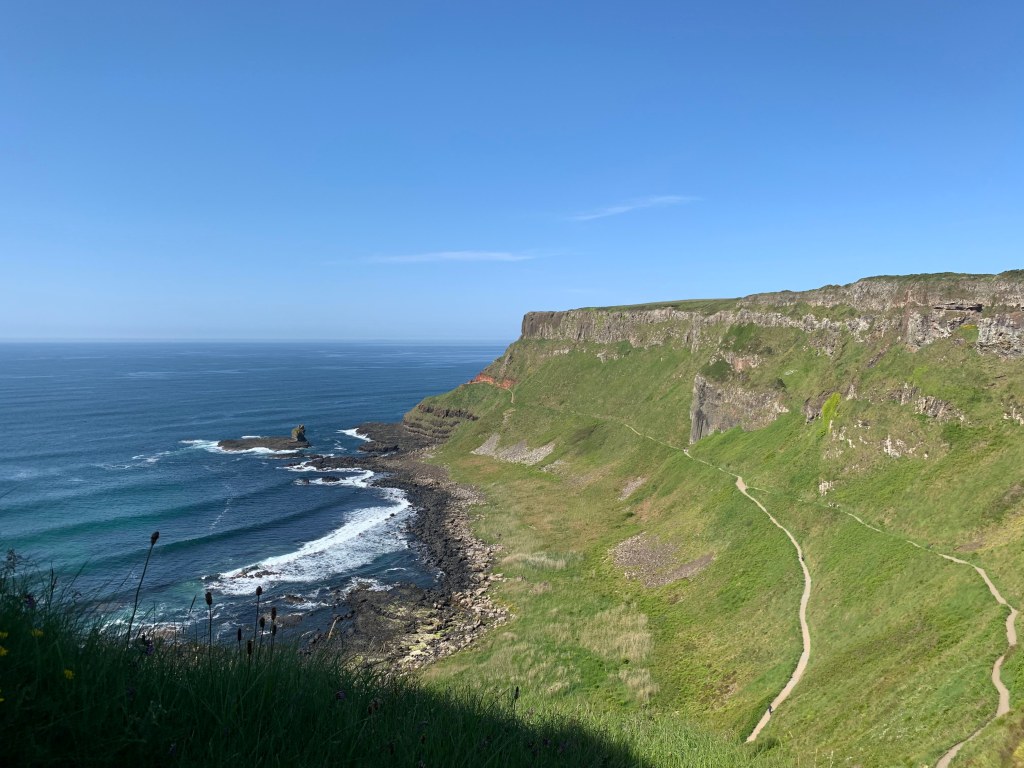
Before I reached the bottom of the hill, The Giants Causeway greeted me with a familiar salty and briny breeze, a typical ocean fragrance that felt familiar and welcoming for our final stop. The formation was unreal. Even if it weren’t for the 40,000 hexagon basalt columns shooting out of the ocean side, this sea side area is captivating. The smaller tide pools that swirled to the sides of the formation were crystal clear, the rhythmic waves were soothing, and the sprawling ocean landscape felt huge against the backdrop of the towering mountains above.

I sat with the ocean to the side of the causeway, away from the other photo obsessed tourists, after getting some of my own pictures that I knew wouldn’t do justice to this mystical place. And I reflected:
When it comes to living life with purpose and intention, I don’t want to be like Couscous. He isn’t a risk taker. He isn’t self-sufficient. He is oblivious or uncaring about the life-sustaining resources available just inches below him. I didn’t want to be like the oblivious people staring at their phones ignorant of the beautiful landscape right out the window.
I am increasingly realizing that life has so much to offer and so much joy to bring us. It’s unfair because life is short. My journey to full time travel has proved that things worth pursuing take risk and hard work. But I’m reassured by the idea that there’s no such thing as regret. As I continue to travel our captivating planet, I know that I will never regret taking a step back from my job to live for experiences.
I’m still unsure of the “How’s” of full time travel from a financial standpoint and I still care what people think about my website, my blog, and my social channels. But I have to remind myself that the only failure one can face is the failure of never even trying to pursue your dreams. So here I am trying. And even in destinations and situations that are difficult, I haven’t regretted a single second of it.
If you’re reading this and thinking “Oh how lucky she must be! I wish I could [insert your dream life here],” my message is this: Don’t spend your life watching other people do things that you want to do. Figure out what it is that truly brings you joy and think about how you can pursue what makes you happy.
Life is too short to be in a miserable job, with someone you don’t like, or in debt for material things that lack true meaning. When you take the steps to pursue your dreams, opportunities open up when you least expect it. You don’t have to have all the answers, just the courage to try. Life is short and your moment is now.
“What are you waiting for? What are you saving for? Now is all there is”
George Balanchine
 Traveling With Lola
Leave a comment