Threshold /ˈTHreSHˌ(h)ōld/ : the place or point of entering or beginning
In many ways, Marrakech is special because it exists on a threshold — not fully one thing or another, but between.
You may have an idea of what Morocco is like – maybe you’ve seen the old classic Casablanca or guestimated based on the markets you’ve seen in Aladdin.
The truth is – Marrakech is an unexpected compilation of an old and new world, with its magic revealed around every corner.
Between Europe and Africa
Morocco sits at the top of Northern Africa, a desert oasis just eight miles from Spain across the narrow Strait of Gibraltar. For centuries, it has been a hub of trade, commerce, and culture—connecting Northern Africa and Europe through the exchange of goods, ideas, and knowledge. Marrakech, in particular, has long existed at this crossroads, shaped by both European and North African influence. Its history of attracting artists and designers—Yves Saint Laurent among them—speaks to the city’s enduring pull.
To understand Marrakech is to see just how in between it is—a layered mix of influences that makes the city feel so distinctive.
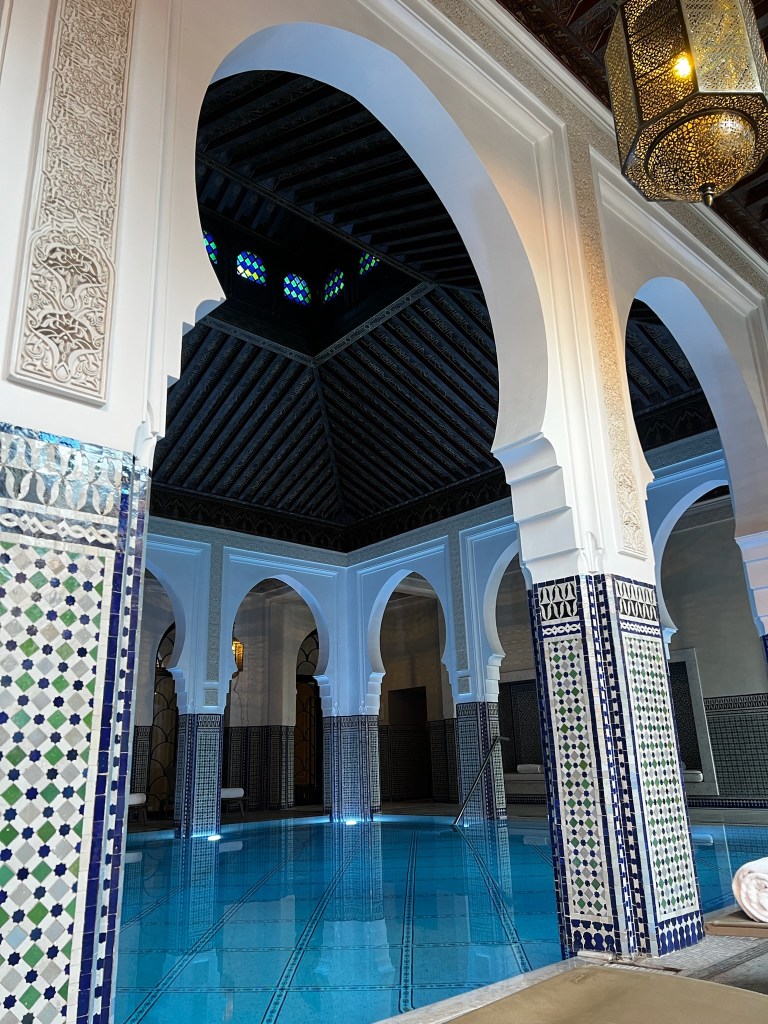
Between an old and new world
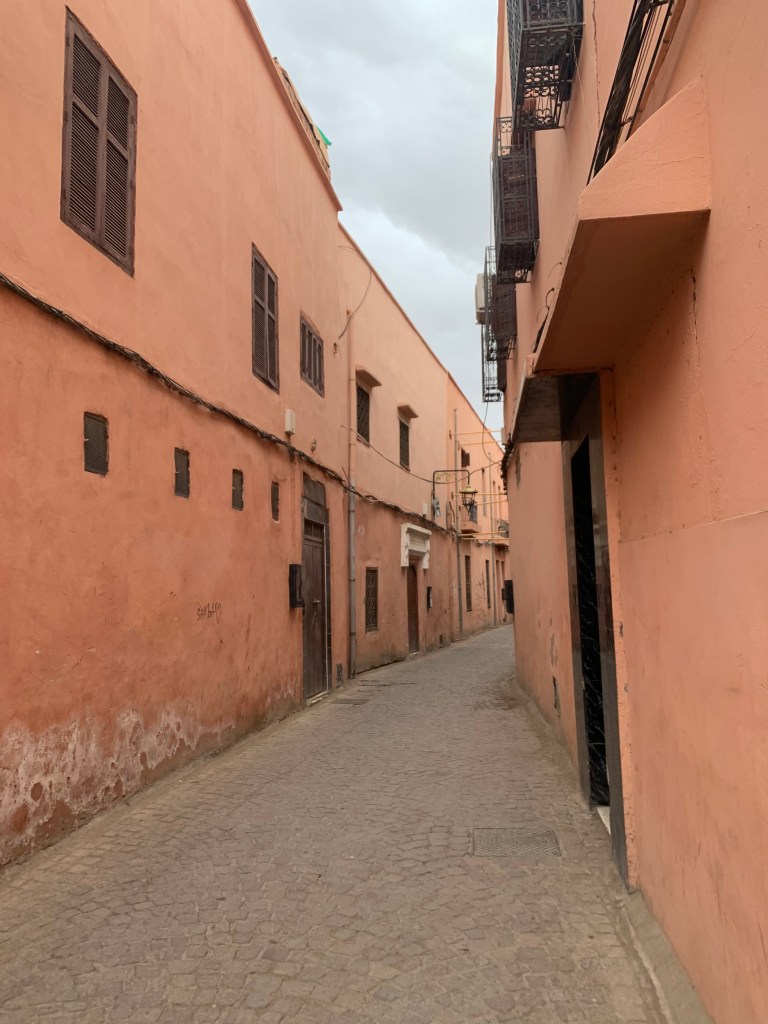
In the early 12th century, the Almoravids began building the walls of Marrakech—the fortified perimeter that still encloses the city’s historic heart, the medina. More than defensive barriers, these salmon-colored walls shaped Marrakech socially, politically, and even psychologically. Stretching over 11 miles and rising more than 30 feet high, they continue to define the old city today. And much like centuries ago, life inside those walls still hums with commerce, creativity, and controlled chaos.
“People are still being creative and bringing things from their own places,” our guide Ibrahim told us as he led us through the markets on a private tour of the medina.
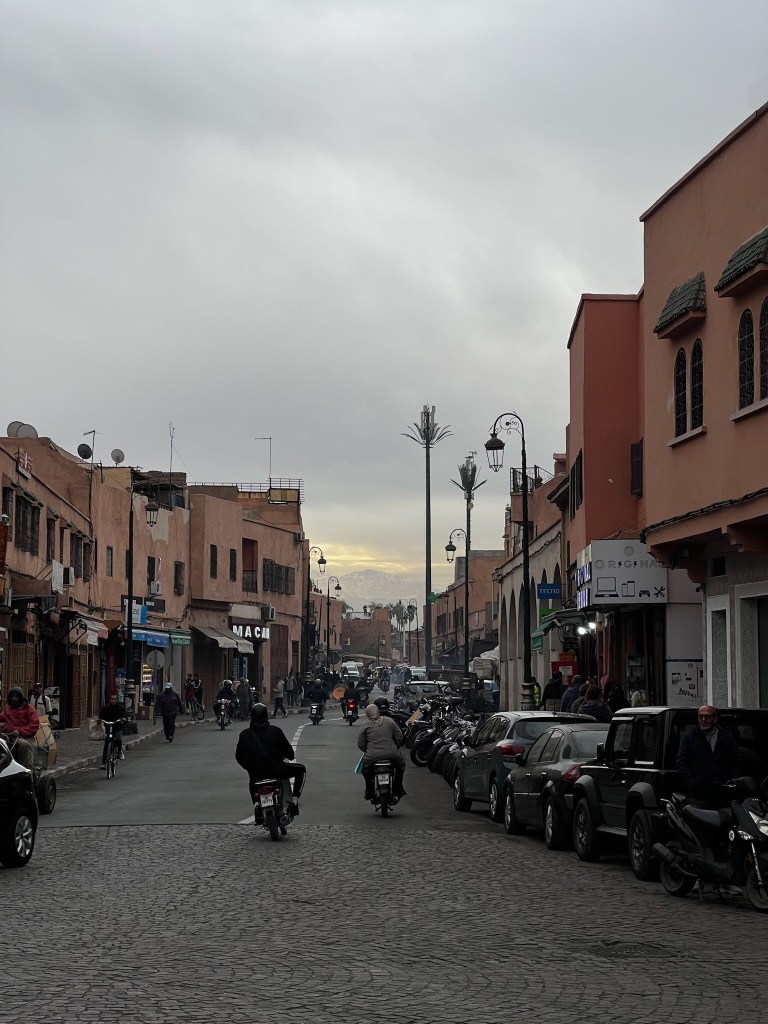
The moment you step through one of the pink-tinged gates, it feels like crossing a threshold in time. Outside the walls, traffic snarls—cars, scooters, and bicycles weaving together in a constant, honking ballet. Inside, the medina belongs almost entirely to pedestrians. The streets tighten, cobblestones pressing inward as you move deeper toward the belly of the old city. More than 30,000 stalls packed into just a few square miles blur into a living maze of color and motion.
For the most part, motorized vehicles aren’t allowed, but don’t get too comfortable. Locals on motorbikes occasionally appear out of nowhere, threading themselves through impossibly narrow lanes. (Pro tip: stick to the right and listen for the hum behind you.)
The medina’s alleyways act like funnels—tall walls and patchwork awnings trapping sound and scent and pushing them straight at you. Smoke from grilling meat mingles with sweet mint tea and leather tanned in the sun. Around every confusing corner, artisans hammer intricate copper designs that will eventually become glowing Moroccan lamps. Nearby, chefs roast corn over open flames while crepe masters flip paper-thin batter into every sweet and savory variation imaginable.
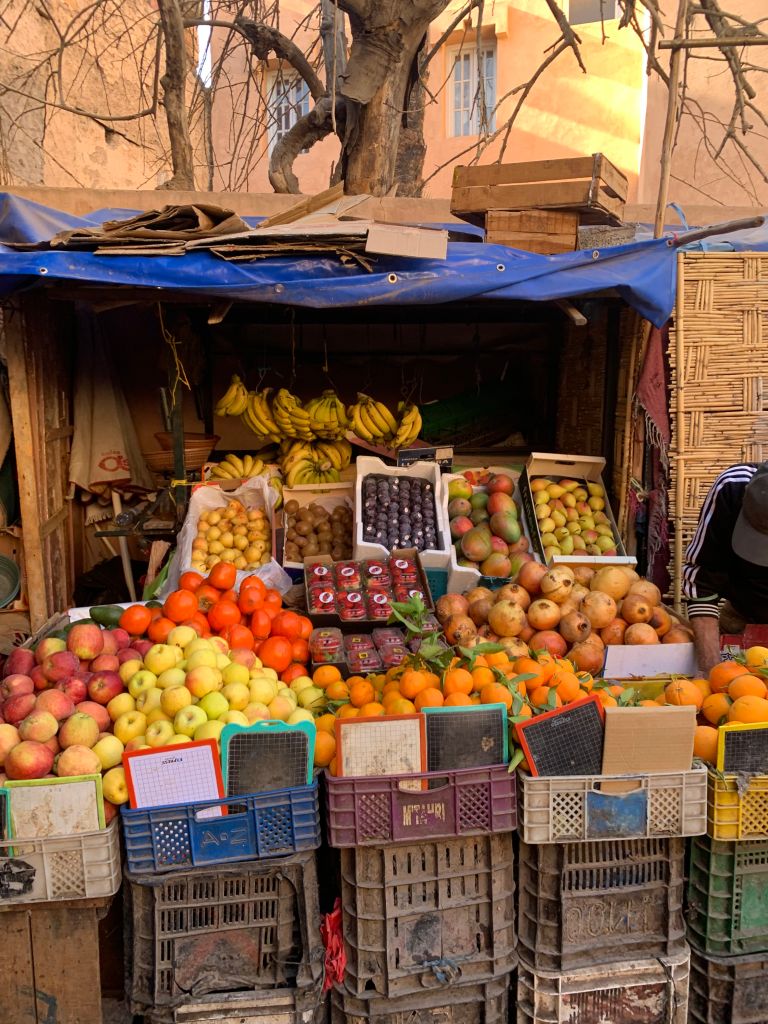
Eventually, the maze opens into Djemaa el-Fna, the pulsing heart of the medina. The vast square is ringed by fruit stands stacked high with jewel-toned displays, while snake charmers pierce the air with shrill flute notes, coaxing their serpents into slow, hypnotic sways. It’s loud, theatrical, and overwhelming—in the best possible way.
Many travelers are hesitant to venture too far into the medina, intimidated by the lack of clear directions and spotty cell service that can leave even seasoned explorers disoriented. But it’s deep within these winding streets that Marrakech reveals itself. That’s where the real treasure lies.
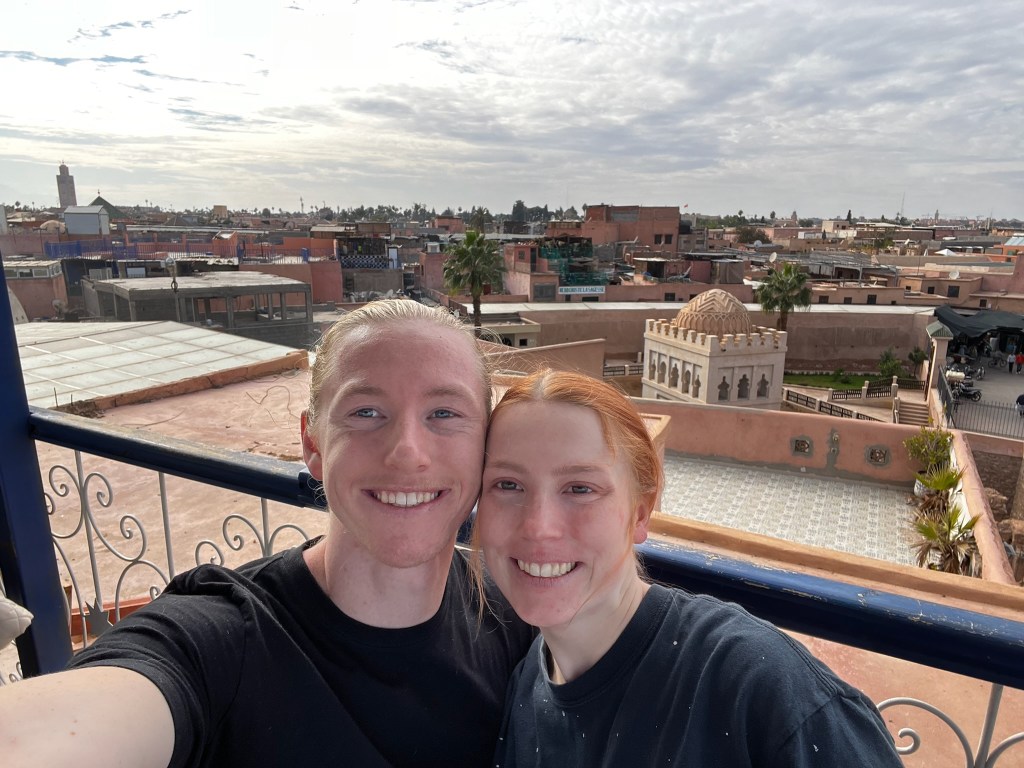
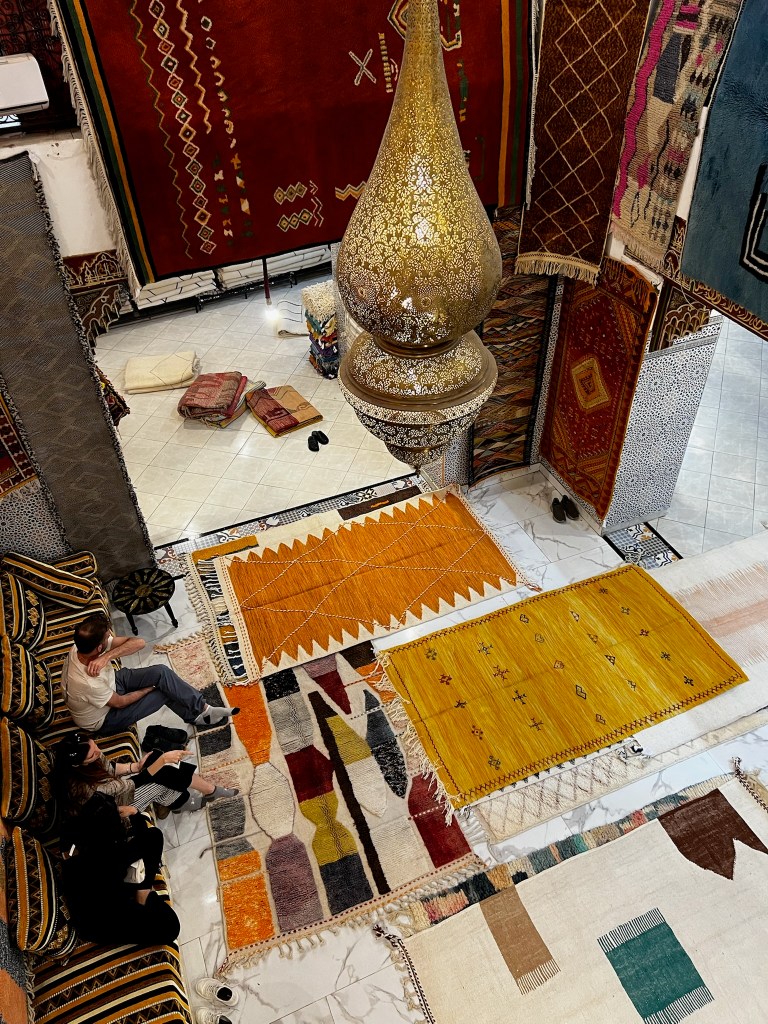
Those willing to go further will find the souks—seven distinct markets dedicated to different crafts. Leatherworkers, lamp makers, carpet weavers, textile sellers, potters—all practicing skills passed down through generations. It’s here, amid the clatter of tools and the rhythm of bargaining voices, that Moroccan artistry feels most alive—and where Marrakech stops being something you observe, and becomes something you experience.
Navigating Marrakech: Markets, Souks & Cooperatives
Market: A lively spot to grab everyday goods, snacks, or souvenirs—casual, colorful, and full of local flavor.
Where to find: scattered around the city, often near main streets, squares, or tourist areas.
Souk: A traditional medina marketplace where narrow lanes are lined with stalls of leather, rugs, spices, and lanterns—perfect for wandering and discovering hidden treasures.
Where to find: deep inside the medina; follow the signs or ask a local for directions to the main souks.
Cooperative: A community-run workshop where artisans craft handmade goods, often supporting local women or farmers—authentic, ethical, and beautifully crafted.
Where to find: often just outside the medina or tucked into quiet streets; look for signage or ask guides for cooperatives specializing in leather, textiles, or pottery.
Helpful Hint: Start your trip with a souk and market tour on Day 1. A guide can show you the best stalls, explain the history behind the crafts, and teach you how to tell which goods are authentic—so you can shop with confidence and spot hidden treasures without getting lost in the maze of the medina.
When walking through the markets of Marrakech, it’s impossible not to be dazzled by the chaos—the buzz of locals buying groceries, bargaining for the best price, and moving through the narrow lanes is intoxicating. That energy, that vibrancy, is completely addictive.
Between Mountains and Desert
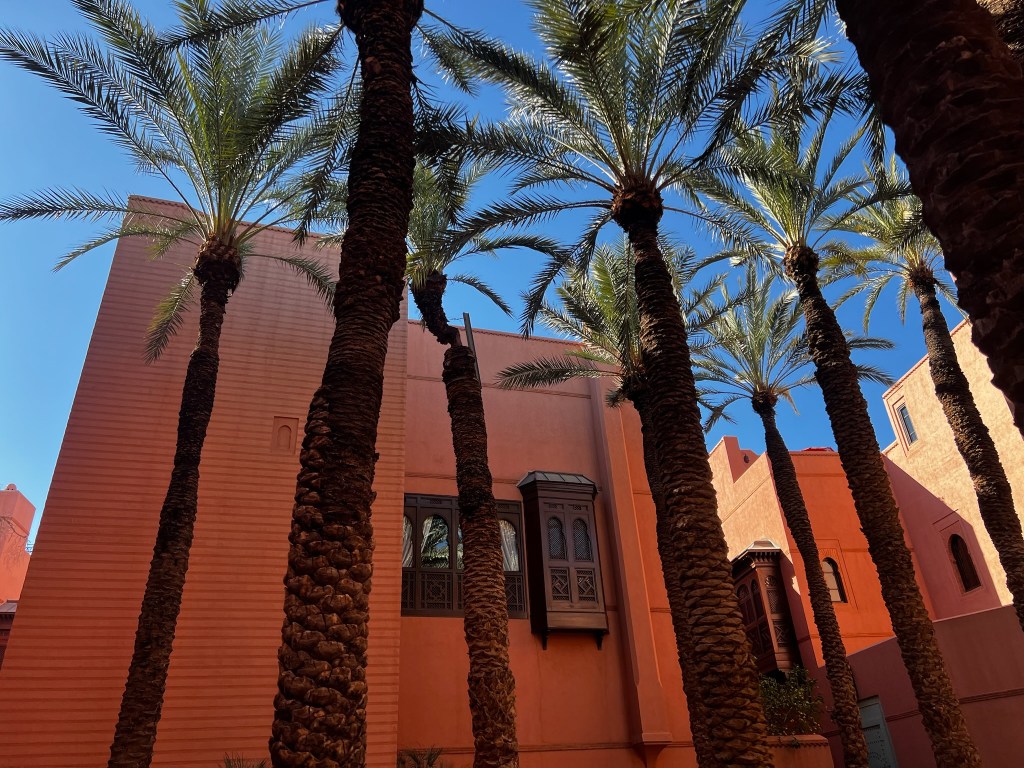
Marrakech—often called the Red City for the reddish-pink sandstone and clay used throughout its buildings—feels like an oasis, and in many ways, it is. The city exists thanks to a rare stroke of geographic luck.
That same fortune drew the Almoravids, an Indigenous Berber group from the Sahara, to establish a military encampment here in 1062. Reliable access to groundwater made settlement possible, and over time, a city emerged—sustained by khettaras, underground canals that carried water from the foothills of the Atlas Mountains into the growing medina.
Marrakech sits on the Haouz Plain, a wide basin of porous soil and gravel that acts like a natural sponge. Instead of evaporating or washing away, water from the Atlas collects underground, remaining accessible even in an arid landscape. Just 45 minutes south, the High Atlas Mountains rise dramatically, receiving far more rainfall than the surrounding desert. For centuries, the city below has quietly depended on the runoff flowing down from those peaks.
If you’re traveling to Marrakech, pairing it with a few days in the Atlas Mountains isn’t just recommended—it feels essential. Where Marrakech is lively, chaotic, loud, and endlessly buzzing, the Atlas Mountains offer something entirely different: space to exhale, reconnect with nature, and slow down in a way the city doesn’t allow.
The drive alone forces a shift in pace. The road winds tightly around mountainsides, each narrow pass demanding your attention—and your patience. With every turn, the scenery unfolds in small, intimate moments: roadside fruit and vegetable markets, goat herders guiding their flocks across the road, village dogs lounging in the dust, children kicking soccer balls between stone homes. Donkeys, still vital here, move steadily along the shoulders, carrying textiles, crops, and supplies from one village to the next. Long before arriving, the spiritual slowing begins.
Luxury Retreat, Local Influence
A taste of this mountain magic can be found at Kasbah Tamadot, a five-star luxury retreat owned by Richard Branson’s Virgin Limited Edition collection. While the name and reputation suggest grandeur, the experience feels surprisingly personal.
Arriving at Kasbah Tamadot is a bit like approaching a guarded fortress—but once inside, it reveals something far warmer. It feels less like a hotel and more like being welcomed into a friend’s enchanted hillside castle. Perched above the village of Asni, the property blends seamlessly into its surroundings, with views stretching across the valley below.
The Berber Tented Suites, tucked into the hillside, are especially magical. Romantic and private, they offer a true sense of seclusion. From floor-to-ceiling windows or your own quiet terrace, Asni unfolds below you—its patchwork of fields, homes, and winding paths framed by the mountains beyond.
Wandering through the gardens—past the heated pool, toward the tennis courts, family riads, and the second on-property restaurant—you’re rewarded with sweeping views of the Asni Valley. Even during our stay, when mist rolled in and rain softened the landscape under gray skies, the beauty never faded. If anything, the lush gardens, green fields, and ripening olive trees felt even more alive.
Standing there, surrounded by mountains and silence, I finally understood why so many people call the Atlas Mountains the most beautiful place in Morocco.
On our way back from lunch at Olinto—a stunning Atlas Mountain retreat tucked into the hills, where incredibly private riads disappear into layers of greenery, and three glistening swimming pools overlook the dramatic folds of the Atlas Mountains— we decided to stop at a roadside market to spend the last of our cash. We had exactly 70 Moroccan dirhams left (about $7.50 USD), and it felt like the perfect excuse to pull over and linger somewhere unplanned.
We spotted a small roadside stall beside a produce stand and walked up to the shopkeeper, greeting him with a hopeful “Merci.” French is one of Morocco’s most widely spoken languages (along with Arabic), and thankfully, he greeted us back in French. He began asking questions, and we quickly realized we had reached the outer limits of our language abilities. We apologized—awkwardly—and he smiled patiently, unfazed.
As I browsed, I realized this little shop had everything. It was organized like a New York City bodega, but unmistakably Moroccan: shelves stacked with local snacks, drinks, chocolate bars, mint tea, and even hygiene products. A true one-stop shop for the surrounding villages.
I piled the scale high with Moroccan specialty snacks—chicken-flavored potato chips, mint tea, Kit Kat–esque wafers, strawberry chocolate bars, and a few things I couldn’t identify but wanted to try anyway. When I asked for the total, the shopkeeper scribbled a number on a piece of paper. I read it as “75.”
My stomach dropped. We had closer to 65 dirhams.
I tried to explain—through gestures, broken French, and a lot of pointing—that we didn’t have enough. I motioned to remove a few items from the scale and showed him the coins in my hand. As I reached for the snacks, he suddenly started shaking his head, repeating “No, no,” and gesturing urgently.
For a brief moment, I panicked. I worried he thought we were trying to cheat him.
Then he reached toward my hand, took the coins, and counted out only 35 dirhams—about $3.83 USD—for the entire overflowing pile of snacks.
I froze.
This man could have easily taken advantage of the language barrier. I had misunderstood him. I wouldn’t have known the difference. Instead, he chose honesty—and generosity—without hesitation. No explanation needed. Just a quiet act of kindness exchanged between strangers.
That moment has stayed with me more than many of the grand sights or luxurious experiences of the trip.
“Marrakech is for everyone,” our guide Ibrahim told us during our souk tour earlier that week. And he was right. Marrakech—and Morocco beyond it—does have something for everyone. But more than that, its people invite you in gently, without spectacle, and leave a lasting impression in the smallest, most human ways.
It’s a place that welcomes you in—and quietly captivates you.
 Traveling With Lola
Leave a comment