
I watched with bated breath as our rickshaw driver seamlessly navigated the overwhelming, intense, chaotic traffic, passing motorbikes, cars, and fellow rickshaws with mere centimeters to spare.
The rickshaw, a bicycle with a buggy-wagon attached to the back, offered us a slight elevation above the walking crowd, making the perfect perch for witnessing the scene that unfolded around us: Thousands of men, women, and children, some in Saris (the traditional Indian garb for women), some in turbans, many with open toed flip flops, Western style t-shirts, and basketball shorts.


The crowds were accompanied with a chorus of car horns, motors, and the buzz of people moving around us. The industrial setting was reinforced by the giant masses of wires that hung all above and around us, as we glided through the streets of the old town markets in Delhi, India.
At the heart of the market, we disembarked from the rickshaws on a mission to locate a tea shop, requiring us to push through dozens of stalls with every imaginable product for sale. Along the way, mountains of grains, candies, seeds, goodies, some recognizable and many completely unknown to me, were piled in each vendor’s area.

In many ways, these market stalls represent India itself: The archetype of products and people were sometimes familiar, sometimes not. The closer I looked, the more unrecognizable things became, but the more its mysteries drew me in. And this was just the beginning of my trip to the beautiful subcontinent of India.
“Don’t try to understand India on this trip,” our wonderful local guide Jaya told our EF Ultimate Break tour group on our first day together. “You’re not going to understand it. Many Indians don’t even understand it”.
She was right. I think that’s why it’s taken me so long to write this blog, because it’s taken me this long to process everything we experienced abroad. And I’m still grappling with it!

Let me drop a few facts to try and contextualize why India is such a hard country to grasp:
- India is now the most populous country in the world with over 1.4 billion residents
- India has more billionaires than the United Kingdom
- There are over 30 major languages spoken across India
- And India’s geography, cultures, and people are as diverse, if not more, than Europe’s.
No wonder it feels like I barely scratched the surface of this lovely, gorgeous, historic, overwhelming, and magical country.
To jump backward in time, my visit to India began after arriving in India via Air India Business Class. I’m mentioning this not to brag that I flew business class, but more to brag that I did it using my credit card points. How much did I spend on this flight? $120 Canadian dollars. For real. (Learn how I did it by checking out this video of my experience!)
The joy of booking my direct flight from New York to New Delhi airport was that I arrived 12 hours ahead of my fellow travelers. After meeting my driver at the airport, we stepped outside into what felt like a furnace. The humidity and heat were excruciating, even in mid-May, and this is coming from a Southern girl who is used to brutally humid Arkansas summers.
The blasting air conditioner of my transfer vehicle was a welcome relief, and allowed me to watch the chaos of New Delhi unfold around me. Traffic laws didn’t seem to be in existence, yet there was a definite strategy and systems in the thousands of cars, buses, motorbikes, and electric “autos” (think: tuk tuks) that zoomed all around us.
I would later learn that horns are a way of communication in India, a “beep beep” is code for “I’m driving beside you and I’m about to pass” or “I’m coming into this lane”. It was beautiful and terrifying to watch this unfold, but in many ways the adrenaline rush of this experience was captivating.
After refreshing myself in the hotel, I met up with Jaya for the first time for some exploration before the rest of my tour group arrived that evening. I told her to take me wherever she felt best, so despite the brutal heat, she escorted me to the Qutub Minar site, New Delhi’s first Unesco World Heritage site.
The centerpiece of the site is the Qutub Minar itself, a towering minaret standing at approximately 73 meters (240 feet) tall, making it the tallest brick minaret in the world. It was built by Qutb-ud-din Aibak, the founder of the Delhi Sultanate, in the late 12th century.
The complex also includes several other historically significant structures, such as the Quwwat-ul-Islam Mosque, which is one of the earliest surviving mosques in India, and the Iron Pillar of Delhi, known for its rust-resistant composition and inscriptions dating back to the 4th century CE.
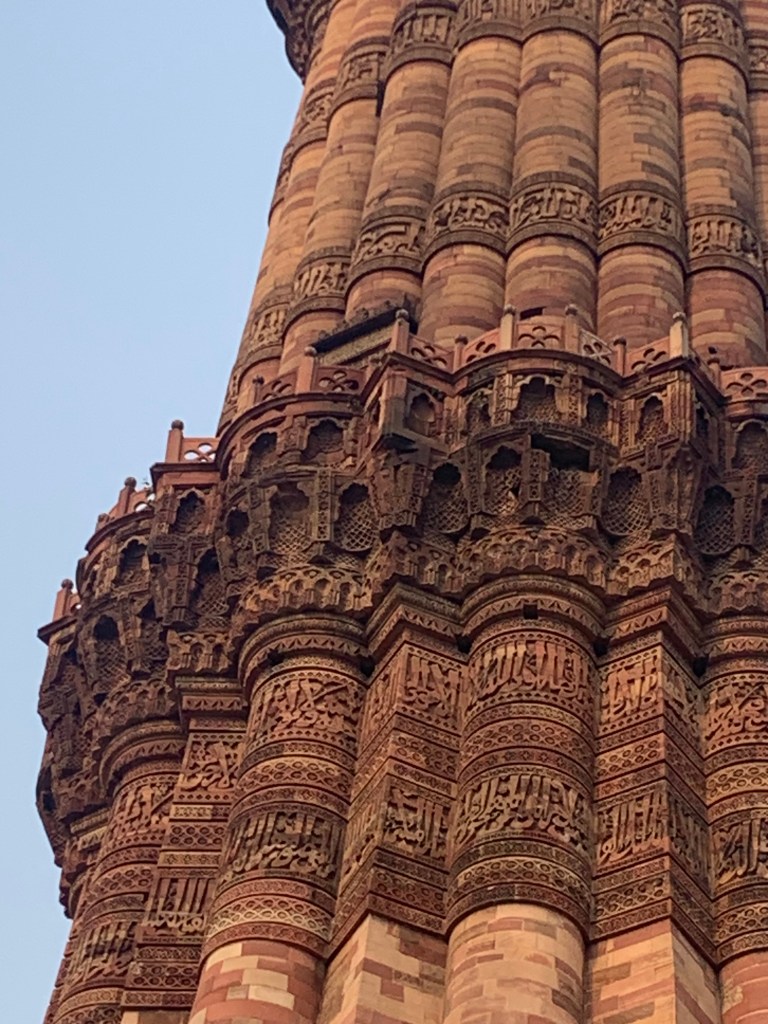
We strolled the site, noticing the subtle details of the Mosque, which was built using materials from Hindu and Jain temples that were demolished during the construction of the mosque. This is evident in the reused pillars and carvings, which display a mix of Hindu, Jain, and Islamic motifs
You’d think I was one of the original founders of the site, the way many tourists began snapping photos of me instead of the gorgeous, towering, ancient site spread around us. As I would quickly learn, Westerners are regarded with almost celebrity status in India, especially during low-season for tourists. (The typical tourism season in India is typically Winter, December to early March to beat the heat). Over the course of the trip, we had dozens of people come up and ask to take a picture with us, or blatantly take photos of our group without asking. My sympathies go out to all real-life celebrities that deal with this on a daily basis!

As the sun began to slowly fade on the brick red structures around me, it dawned on me that this complex, and the whole experience so far had seemed so unreal. The very complex I was walking on was over twice as old as The United States. The people, sites, and sounds all around me felt totally new. Where the hell was I?
The next morning after my economy-class traveling companions had arrived, we enjoyed hotel breakfast (Careful to avoid all cut fruit, non-bottled water and “iced” coffee) and prepared to visit Humayan’s Tomb, the inspiration of the Taj Mahal.
The tomb itself is a huge, commanding structure, but it’s the details of the site of the grounds that may be the most admirable. Humayan’s Tomb is situated within a large complex that also houses the tombs of other members of the Mughal royal family. The complex is known for its Persian-inspired Charbagh (four-quartered) garden layout, divided into symmetrical quadrants by pathways and water channels.
The layout of the garden is supposed to be a shout out to the Islamic understanding of paradise, making this area a literal representation of heaven on earth.
The next day as we traveled to Agra, it was time to visit the Taj Mahal. And yes, it was about as gorgeous and large as you would imagine.

I would be remiss not to mention this fact in order to set the story straight for my 20 blog readers. The story most people know is that the Taj Mahal was built by the Fifth Mughal Emperor Shah Jahan, in honor of his dear departed wife Mumtaz Mahal.
As it turns out, this story of romance is wrong. The primary reason Shah Jahan built this complex was for political and economic motivations, intimidating rivals and leaving his legacy behind. To further upend this story of romance, Shah Jahan even had his own tomb constructed inside the Taj, placing his own grave closer to “God” by constructing a tomb more West than his wife’s tomb. This symbolizes that he is more important to God than his wife, while simultaneously disrupting the perfect symmetry inside the tomb, which usually represents oneness and sameness with God. Self-important much??

As we strolled the gorgeous, manicured complex, I couldn’t help but think that it seems a shame that so much work was put into a structure that could only be celebrated after death. However, I felt grateful for the opportunity to visit one of the Seven Wonders of the World in this lifetime.
My next magical moment in this country came in Ranthambore, the tiger capital of India. As I crammed into an open-top safari car, I felt giddy as we rushed along through the morning air into Ranthambore National Park, known for its significant population of Bengal Tigers.
The faint sunrise of our early-morning game drive began to illuminate the unbelievable scenery around us as we neared the park: dense forests, grasslands, and rocky hills, which provide an ideal habitat for tigers and other wildlife.
We entered the park under the watchful eye of the Rhesus Monkeys perched in the trees along the road. We watched deer, squirrels, and boar root around in the open fields and shaded areas of the park. The prized sight of the park is of course The Bengal Tiger. There are estimated to be over 80 tigers in the park and over 4,000 in the whole of Rajasthan.
Then our safari guide got a tip: Bengal tigers had been spotted by the lake!
We took off across the terrain, scaling impossibly sharp inclines and narrow roads, making our way through the trees until we spotted them: the rare sighting of Ranthambore’s queen Tiger, Rithi, and her cubs, dozing peacefully by the lakeside.
We sat there for what felt like hours, watching them through binoculars occasionally flick their tail or lift their head to smell something while dozing in the hot Indian summer. They may have realized we were there, but they slept peacefully knowing we were just visitors, respecting their lovely home.


India was chaotic, beautiful, unbelievable, sensitive, detailed, and magical. Throughout the trip, there was something I could never quite put my finger on, a sort of sense that things around me had a certain weight, a certain history and establishment that transcended me, this trip, and this place.
In travel today, there exists almost a devastating sameness that infects many large cities with western influence. What makes travel really special is those places moments where everything, the people, sites, and culture, feel completely new.
This is what I was sensing here, a profound feeling of unrecognition in the best way. The buzz of India is rooted in an ancient history, juxtaposed with a cosmopolitan modern society. You can’t help but feel the infectious sense of newness. Places like this open the door for true exploration, and it’s invigorating with a childlike sense of wonder.
Many religious groups in India see death as not an end but as a transition to another state of existence. In a way, this visit to India transported me to another dimension of existence, one where history is both ancient and breathing all around me, evident in the rhythmic honking of traffic and peaceful quiet of sleeping tigers, all in one border.


 Traveling With Lola
Leave a reply to shannonlynnj11 Cancel reply